
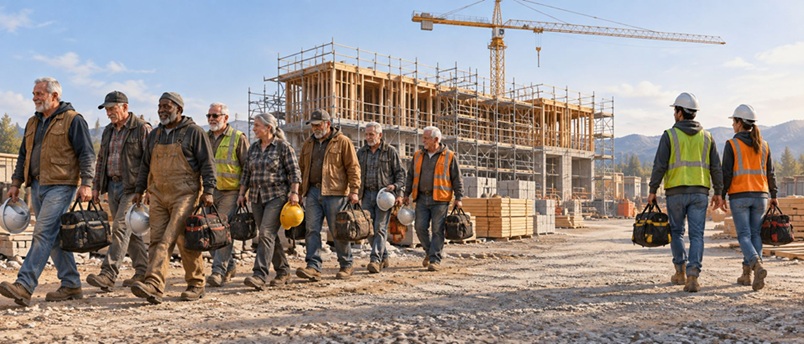
This is the first of two articles examining the ongoing shortage of workers in the construction industry and the efforts underway to address it. When the second article has been published we will include a link here.
The construction labor crisis did not appear overnight. During the great recession and housing collapse, builders closed, projects stalled, and many skilled tradespeople left construction for other industries. e2Value previously examined the factors contributing to today’s workforce challenges in For Want of a Sink the House Was Lost: Construction Labor Shortage Continues.
Today, several pressures continue to constrain the labor market. An aging workforce is retiring faster than employers can replace it, while demand from housing, infrastructure, advanced manufacturing facilities, and large data center projects is intensifying competition for skilled tradespeople. Immigration-related workforce challenges and a persistent skills gap further complicate hiring efforts. According to the Associated General Contractors of America (AGC), 57% of firms report that available applicants lack the skills, training, or licensing needed for open positions.
The challenge remains significant. Associated Builders and Contractors (ABC) estimates the industry must attract 349,000 net new workers in 2026 to meet anticipated demand.
AGC also reports that 92% of construction firms are struggling to find qualified workers and that labor shortages have become a leading cause of project delays.
Training and Credential Programs
States, contractors, trade associations, community colleges, and workforce coalitions are responding with apprenticeships, technical education, paid training, and credential programs designed to attract new workers to the skilled trades. For example, America’s Workforce Academy, a partnership between ABC and Meta, provides training and industry-recognized credentials tied to construction and AI infrastructure projects.
Additional initiatives are emerging nationwide to introduce students and career changers to construction careers and expand the talent pipeline.
Technology and Automation
Technology may also help ease labor pressures. Robotics are increasingly being explored to automate repetitive or physically demanding tasks and improve productivity on jobsites.
However, research published by the National Association of Home Builders indicates that many skilled trades remain difficult to automate. Occupations such as carpenters, roofers, construction laborers, and operating engineers depend heavily on physical work, changing jobsite conditions, safety judgment, and coordination among trades. While AI may improve planning, estimating, scheduling, and document management, skilled trade labor remains essential to the construction process.